


3D Visualization
3D for everyone: Faster decisions and better results with 3D product data
Make model geometry available at every workstation
3D models are becoming increasingly important for visual decision support in product development. However, in many companies, only a few employees have direct access to them. Due to the high license costs for CAD systems, companies often rely on standalone viewers, which are extremely inefficient due to their lack of integration into PLM processes. The consequences are cumbersome coordination via screenshots, media breaks between email and PLM, isolated communication without current data context, and ultimately avoidable errors in decision-making. With CONTACT Elements 3D Connect, you solve this problem: Model geometry becomes an integral part of your processes and is seamlessly available at every workstation.
Your benefits
- Better processes with model data at your fingertips
- Visual analyses and decisions with the 3D cockpit
- Easily share model data for team collaboration
- Simple handling of model data with 3D-PDF, JT, and STEP
- Digital Mockups for accelerated product validation

Optimize processes with model data on demand

With 3D Connect, you can leverage 3D models without a separate CAD system or expensive viewers. It significantly simplifies visualization and analysis tasks, making geometry information accessible throughout the entire company. The result: noticeably more efficient processes, for example, by creating 3D PDFs with illustrated Bills of Material (BOMs) for customer and online documentation, the direct evaluation of changes (redlining) within the model as part of Engineering Change Management, or by utilizing Digital Mockups (DMU) for early, robust design validation.
Optimize processes with model data on demand
With 3D Connect, you can leverage 3D models without a separate CAD system or expensive viewers. It significantly simplifies visualization and analysis tasks, making geometry information accessible throughout the entire company. The result: noticeably more efficient processes, for example, by creating 3D PDFs with illustrated Bills of Material (BOMs) for customer and online documentation, the direct evaluation of changes (redlining) within the model as part of Engineering Change Management, or by utilizing Digital Mockups (DMU) for early, robust design validation.

With 3D Connect, you can leverage 3D models without a separate CAD system or expensive viewers. It significantly simplifies visualization and analysis tasks, making geometry information accessible throughout the entire company. The result: noticeably more efficient processes, for example, by creating 3D PDFs with illustrated Bills of Material (BOMs) for customer and online documentation, the direct evaluation of changes (redlining) within the model as part of Engineering Change Management, or by utilizing Digital Mockups (DMU) for early, robust design validation.
Leverage the 3D Cockpit for visual analyses and informed decisions

3D Connect is integrated into CONTACT Elements and CIM Database PLM. In the 3D Cockpit, you directly access CAD model data, parts, variants, product structures, and BOMs. The 3D Cockpit is the central tool for intuitive navigation through complex model and product structures. Your developers use measurement functions, exploded views, and redlining for commenting. They save snapshots of selected views and use color coding to display component properties, such as release status, directly in the model.

Leverage the 3D Cockpit for visual analyses and informed decisions
3D Connect is integrated into CONTACT Elements and CIM Database PLM. In the 3D Cockpit, you directly access CAD model data, parts, variants, product structures, and BOMs. The 3D Cockpit is the central tool for intuitive navigation through complex model and product structures. Your developers use measurement functions, exploded views, and redlining for commenting. They save snapshots of selected views and use color coding to display component properties, such as release status, directly in the model.
3D Connect is integrated into CONTACT Elements and CIM Database PLM. In the 3D Cockpit, you directly access CAD model data, parts, variants, product structures, and BOMs. The 3D Cockpit is the central tool for intuitive navigation through complex model and product structures. Your developers use measurement functions, exploded views, and redlining for commenting. They save snapshots of selected views and use color coding to display component properties, such as release status, directly in the model.
Share model data for team collaboration
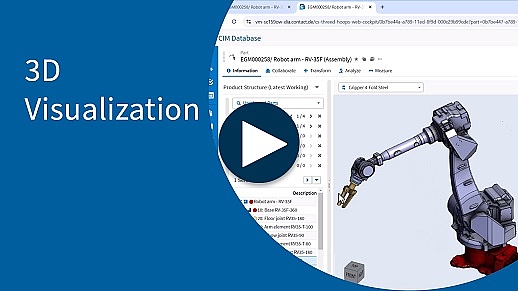
With 3D Connect, you make internal coordination and collaboration with customers and suppliers highly efficient. You share model data and analysis results directly within the process – from visual component information, redlinings, and comments to notes and views. You can propose, discuss, and evaluate changes directly in the context of the models. This significantly accelerates central processes like engineering changes.
Share model data for team collaboration
With 3D Connect, you make internal coordination and collaboration with customers and suppliers highly efficient. You share model data and analysis results directly within the process – from visual component information, redlinings, and comments to notes and views. You can propose, discuss, and evaluate changes directly in the context of the models. This significantly accelerates central processes like engineering changes.
With 3D Connect, you make internal coordination and collaboration with customers and suppliers highly efficient. You share model data and analysis results directly within the process – from visual component information, redlinings, and comments to notes and views. You can propose, discuss, and evaluate changes directly in the context of the models. This significantly accelerates central processes like engineering changes.

Multimodal similarity search for 3D models
Extensive 3D CAD databases make it difficult to reuse designs effectively. Leveraging the Fourier AI Cloud, integrated into CONTACT Elements, we provide you with a multimodal similarity search. This enables you to precisely identify existing or similar parts, assemblies, and associated documents across various data formats (text, image, 3D CAD). The AI developed by CONTACT renders time-consuming manual search processes obsolete. Your company benefits from a well-conceived, intuitive, and fast process for data reuse.
Multimodal similarity search for 3D models
Extensive 3D CAD databases make it difficult to reuse designs effectively. Leveraging the Fourier AI Cloud, integrated into CONTACT Elements, we provide you with a multimodal similarity search. This enables you to precisely identify existing or similar parts, assemblies, and associated documents across various data formats (text, image, 3D CAD). The AI developed by CONTACT renders time-consuming manual search processes obsolete. Your company benefits from a well-conceived, intuitive, and fast process for data reuse.
Multimodal similarity search for 3D models
Extensive 3D CAD databases make it difficult to reuse designs effectively. Leveraging the Fourier AI Cloud, integrated into CONTACT Elements, we provide you with a multimodal similarity search. This enables you to precisely identify existing or similar parts, assemblies, and associated documents across various data formats (text, image, 3D CAD). The AI developed by CONTACT renders time-consuming manual search processes obsolete. Your company benefits from a well-conceived, intuitive, and fast process for data reuse.
Easily handle model data with 3D-PDF, JT, and STEP
3D PDFs combine product models with the versatility of Office documents. Working with model data becomes as intuitive as working with texts and images. You can directly display Product Manufacturing Information (PMI) – such as dimensions and tolerances – as well as model views defined in the CAD system. You combine model information with metadata and interactive controls directly in the PDF by utilizing document templates and form elements. The associative BOM entries reflect the selection of 3D components in the BOM (and vice versa). PDF, JT, and STEP files can be easily and widely shared.

3D PDFs combine product models with the versatility of Office documents. Working with model data becomes as intuitive as working with texts and images. You can directly display Product Manufacturing Information (PMI) – such as dimensions and tolerances – as well as model views defined in the CAD system. You combine model information with metadata and interactive controls directly in the PDF by utilizing document templates and form elements. The associative BOM entries reflect the selection of 3D components in the BOM (and vice versa). PDF, JT, and STEP files can be easily and widely shared.
Accelerate product validation with integrated DMU

3D Connect integrates advanced DMU technologies from invenio, one of the leading specialists for Digital Mockups. Benefit from high-end DMU functions at every workstation – without media breaks, extensive setup times, or cumbersome context switching. This includes, for example, Clash & Clearance for quickly identifying all parts that fall below minimum distances. In addition, you can analyze collisions, contact surfaces, and clearance bands in geometry models, and compare model alternatives as well as supplied variants.

Accelerate product validation with integrated DMU
3D Connect integrates advanced DMU technologies from invenio, one of the leading specialists for Digital Mockups. Benefit from high-end DMU functions at every workstation – without media breaks, extensive setup times, or cumbersome context switching. This includes, for example, Clash & Clearance for quickly identifying all parts that fall below minimum distances. In addition, you can analyze collisions, contact surfaces, and clearance bands in geometry models, and compare model alternatives as well as supplied variants.
3D Connect integrates advanced DMU technologies from invenio, one of the leading specialists for Digital Mockups. Benefit from high-end DMU functions at every workstation – without media breaks, extensive setup times, or cumbersome context switching. This includes, for example, Clash & Clearance for quickly identifying all parts that fall below minimum distances. In addition, you can analyze collisions, contact surfaces, and clearance bands in geometry models, and compare model alternatives as well as supplied variants.
Offline and high-performance viewing with ViewStation

Users with specific requirements, for example, for wall thickness analysis or for offline operation, benefit from the complementary use of the dedicated Kisters ViewStation. The maintained 3D Connect integration for CONTACT Elements and CIM Database PLM ensures seamless workflows. ViewStation offers special analysis and authoring functions and is ideal for working on-site with customers, even without direct access to the PLM server services.
Offline and high-performance viewing with ViewStation
Users with specific requirements, for example, for wall thickness analysis or for offline operation, benefit from the complementary use of the dedicated Kisters ViewStation. The maintained 3D Connect integration for CONTACT Elements and CIM Database PLM ensures seamless workflows. ViewStation offers special analysis and authoring functions and is ideal for working on-site with customers, even without direct access to the PLM server services.
Users with specific requirements, for example, for wall thickness analysis or for offline operation, benefit from the complementary use of the dedicated Kisters ViewStation. The maintained 3D Connect integration for CONTACT Elements and CIM Database PLM ensures seamless workflows. ViewStation offers special analysis and authoring functions and is ideal for working on-site with customers, even without direct access to the PLM server services.
Related Elements
DMU De-risk products earlier, faster, and more cost-effectively
Empower every workstation with DMU capabilities
Validate technical changes with automated geometry comparisons
Calculate collisions for optimal decisions about variant-specific geometry
Utilize high-quality image data from CAD models for documentation or marketing
Manage CAx data across disciplines and locations
Consolidate and manage cross-disciplinary CAx data
Optimally support product development
Seamlessly exchange design data with partners and customers
Communicate more easily and efficiently within the team
Targeted information distribution with contextual relevance
Company-wide, customized information delivery
Inspire employees with a new user experience
Manage simulation data and processes in an integrated manner
Make simulation methods available enterprise-wide
Accelerate development and simulation processes through automation
Efficiently integrate CAD and CAE – reduce effort and errors
Clearly establish relationships with consistent data management
Combine customer orientation with efficient value creation
Build product portfolios efficiently and strategically
Achieve the ideal balance between customer orientation and cost-effectiveness
Modularize product variability and manage it consistently throughout the product lifecycle
Maintain transparency and clarity even in complex variant spaces
Automatically supply downstream processes with data
Further information
Would you like to find out more about this topic? Choose one of the following information offers.

