



Enterprise System Connectivity
Organize and leverage knowledge across the enterprise
Data silos slow down agentic AI processes
Engineering knowledge is often isolated in PLM, ERP, or wiki systems. Organizations seeking to run agentic AI processes quickly encounter the limitations of generic AI assistants: without genuine enterprise context, they cannot operate effectively across system boundaries. At the same time, each new integration can involve high costs and rigid vendor lock-in. How can you break down these silos and make data securely usable across systems for intelligent decision-making? Discover how Fourier AI and Enterprise Connectivity can unlock the potential of your systems.
Benefits
- Break down data silos and leverage knowledge across different systems
- Automate cross-system, agentic processes
- Make decisions based on the full enterprise context
- Significantly reduce manual research and coordination efforts
- Connect existing systems and AI solutions openly in both directions

Orchestrate systems and data sources across the enterprise with Fourier AI

Engineering knowledge is distributed across PLM, ERP, CRM, technical databases, and wikis. Efficiency gains emerge only when AI operates across these system boundaries. Enterprise Connectivity enables systems and their AI capabilities to be orchestrated in every direction: Fourier AI accesses other data sources from within PLM via MCP, external AI systems access PLM data in return, and a central AI assistant uses all connected systems together. Users remain in their familiar working environment without switching tools or manually gathering information. This breaks down data silos and enables cross-system agentic processes—initiated by a user or automatically by a workflow trigger.
Orchestrate systems and data sources across the enterprise with Fourier AI
Engineering knowledge is distributed across PLM, ERP, CRM, technical databases, and wikis. Efficiency gains emerge only when AI operates across these system boundaries. Enterprise Connectivity enables systems and their AI capabilities to be orchestrated in every direction: Fourier AI accesses other data sources from within PLM via MCP, external AI systems access PLM data in return, and a central AI assistant uses all connected systems together. Users remain in their familiar working environment without switching tools or manually gathering information. This breaks down data silos and enables cross-system agentic processes—initiated by a user or automatically by a workflow trigger.

Engineering knowledge is distributed across PLM, ERP, CRM, technical databases, and wikis. Efficiency gains emerge only when AI operates across these system boundaries. Enterprise Connectivity enables systems and their AI capabilities to be orchestrated in every direction: Fourier AI accesses other data sources from within PLM via MCP, external AI systems access PLM data in return, and a central AI assistant uses all connected systems together. Users remain in their familiar working environment without switching tools or manually gathering information. This breaks down data silos and enables cross-system agentic processes—initiated by a user or automatically by a workflow trigger.
Create technically sound sales quotations

A customer request for a custom configuration reaches the sales team—and would traditionally be passed on to engineering. With Enterprise Connectivity, a central AI assistant handles the request itself. It reads bills of materials and variant logic from PLM, adds prices, lead times, and material availability from ERP, and considers the customer’s framework agreements and history from CRM. Within minutes, the sales team receives a technically sound calculation, including feasibility information—without a round of questions for engineering or having to research across three systems.
Create technically sound sales quotations
A customer request for a custom configuration reaches the sales team—and would traditionally be passed on to engineering. With Enterprise Connectivity, a central AI assistant handles the request itself. It reads bills of materials and variant logic from PLM, adds prices, lead times, and material availability from ERP, and considers the customer’s framework agreements and history from CRM. Within minutes, the sales team receives a technically sound calculation, including feasibility information—without a round of questions for engineering or having to research across three systems.

A customer request for a custom configuration reaches the sales team—and would traditionally be passed on to engineering. With Enterprise Connectivity, a central AI assistant handles the request itself. It reads bills of materials and variant logic from PLM, adds prices, lead times, and material availability from ERP, and considers the customer’s framework agreements and history from CRM. Within minutes, the sales team receives a technically sound calculation, including feasibility information—without a round of questions for engineering or having to research across three systems.
Evaluate and approve changes with full enterprise context
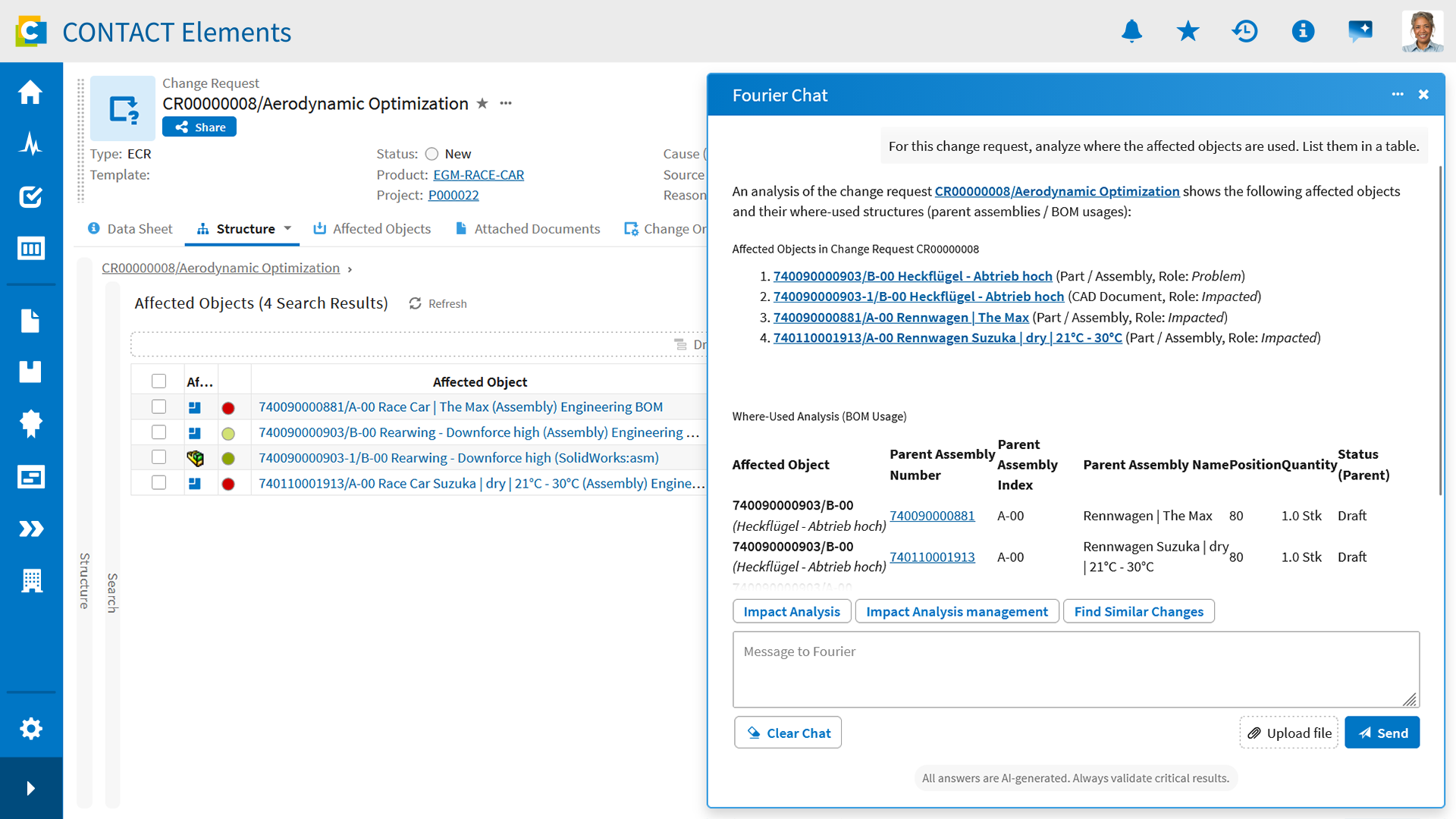
A customer reports a defect and engineering proposes a material change—turning a change request in PLM into a process that affects the entire enterprise. Fourier AI performs the assessment: Via MCP, the AI retrieves geometry and bill-of-material data from PLM, inventory levels and lead times from ERP, and complaints and customer commitments from CRM. Directly in the change request, it shows which assemblies, orders, and customers are affected. Whenever a binding response is required, it consults agents in adjacent systems. The purchasing agent in ERP checks supplier terms and replenishment lead times and identifies the earliest feasible date. Fourier AI writes the result, alternatives, and rationale back to the change request. Engineering can therefore make decisions with full enterprise context instead of enduring a marathon of coordination by email and in meetings.
Evaluate and approve changes with full enterprise context
A customer reports a defect and engineering proposes a material change—turning a change request in PLM into a process that affects the entire enterprise. Fourier AI performs the assessment: Via MCP, the AI retrieves geometry and bill-of-material data from PLM, inventory levels and lead times from ERP, and complaints and customer commitments from CRM. Directly in the change request, it shows which assemblies, orders, and customers are affected. Whenever a binding response is required, it consults agents in adjacent systems. The purchasing agent in ERP checks supplier terms and replenishment lead times and identifies the earliest feasible date. Fourier AI writes the result, alternatives, and rationale back to the change request. Engineering can therefore make decisions with full enterprise context instead of enduring a marathon of coordination by email and in meetings.
A customer reports a defect and engineering proposes a material change—turning a change request in PLM into a process that affects the entire enterprise. Fourier AI performs the assessment: Via MCP, the AI retrieves geometry and bill-of-material data from PLM, inventory levels and lead times from ERP, and complaints and customer commitments from CRM. Directly in the change request, it shows which assemblies, orders, and customers are affected. Whenever a binding response is required, it consults agents in adjacent systems. The purchasing agent in ERP checks supplier terms and replenishment lead times and identifies the earliest feasible date. Fourier AI writes the result, alternatives, and rationale back to the change request. Engineering can therefore make decisions with full enterprise context instead of enduring a marathon of coordination by email and in meetings.
Analyze faults in service and maintenance in seconds

When a problem occurs in the field, every second counts. With Enterprise Connectivity, Fourier AI uses MCP to simultaneously scan the PLM system for component histories, search service tickets in Jira, and identify solutions in the Confluence wiki or intranet. Instead of spending hours researching, the service team immediately receives precise troubleshooting instructions, including source references. This saves valuable time in customer support and preserves internal knowledge across systems.
Analyze faults in service and maintenance in seconds
When a problem occurs in the field, every second counts. With Enterprise Connectivity, Fourier AI uses MCP to simultaneously scan the PLM system for component histories, search service tickets in Jira, and identify solutions in the Confluence wiki or intranet. Instead of spending hours researching, the service team immediately receives precise troubleshooting instructions, including source references. This saves valuable time in customer support and preserves internal knowledge across systems.

When a problem occurs in the field, every second counts. With Enterprise Connectivity, Fourier AI uses MCP to simultaneously scan the PLM system for component histories, search service tickets in Jira, and identify solutions in the Confluence wiki or intranet. Instead of spending hours researching, the service team immediately receives precise troubleshooting instructions, including source references. This saves valuable time in customer support and preserves internal knowledge across systems.
Generate compliance reports automatically

Before a product release, countless regulations must be checked. Via MCP, Fourier AI acts as an active agent: The AI autonomously accesses external standards databases, verifies supplier certificates in ERP, and checks test reports in PLM. The result is a complete, automated compliance report. Deviations are flagged immediately before they cause costly delays in the certification process—compliance assurance at its best.
Generate compliance reports automatically
Before a product release, countless regulations must be checked. Via MCP, Fourier AI acts as an active agent: The AI autonomously accesses external standards databases, verifies supplier certificates in ERP, and checks test reports in PLM. The result is a complete, automated compliance report. Deviations are flagged immediately before they cause costly delays in the certification process—compliance assurance at its best.

Before a product release, countless regulations must be checked. Via MCP, Fourier AI acts as an active agent: The AI autonomously accesses external standards databases, verifies supplier certificates in ERP, and checks test reports in PLM. The result is a complete, automated compliance report. Deviations are flagged immediately before they cause costly delays in the certification process—compliance assurance at its best.
Further information
Would you like to find out more about this topic? Choose one of the following information offers.

