



Semantic Search
Get relevant results in seconds with smart context search
Intelligently find knowledge instead of tedious searching
In complex PLM, engineering, and document management systems, valuable information often lies dormant and unused in data silos. Traditional search methods quickly reach their limits: they only deliver results for exact terms, fail to handle specialized technical jargon, and require detailed knowledge of the data structure. As a result, engineers, service teams, and project teams spend valuable time every day searching for information. Semantic Search in Fourier AI fundamentally changes this process. The solution understands meaning, connections, and domain-specific context. As a result, it finds relevant information immediately – regardless of how it was originally described.
Key Benefits
- Intelligently find information in context across language and discipline boundaries
- Shorten research time, avoid duplicate development, and effectively reuse existing solutions
- Preserve company knowledge and make it accessible independently of individual experts
- Analyze errors faster and accelerate processes

Fast and reliable search results thanks to intelligent context search

Identical content is often hidden behind different terms in documents, metadata attributes, classifications, or geometry. When searching for content, you no longer have to wade through documents, requirements, or varying terminology. Semantic search understands technical relationships and recognizes when different terms share the same meaning – even across language and discipline boundaries. As a result, knowledge is systematically reused, permanently reducing development effort.
Fast and reliable search results thanks to intelligent context search
Identical content is often hidden behind different terms in documents, metadata attributes, classifications, or geometry. When searching for content, you no longer have to wade through documents, requirements, or varying terminology. Semantic search understands technical relationships and recognizes when different terms share the same meaning – even across language and discipline boundaries. As a result, knowledge is systematically reused, permanently reducing development effort.

Identical content is often hidden behind different terms in documents, metadata attributes, classifications, or geometry. When searching for content, you no longer have to wade through documents, requirements, or varying terminology. Semantic search understands technical relationships and recognizes when different terms share the same meaning – even across language and discipline boundaries. As a result, knowledge is systematically reused, permanently reducing development effort.
Smartly reuse components and geometries
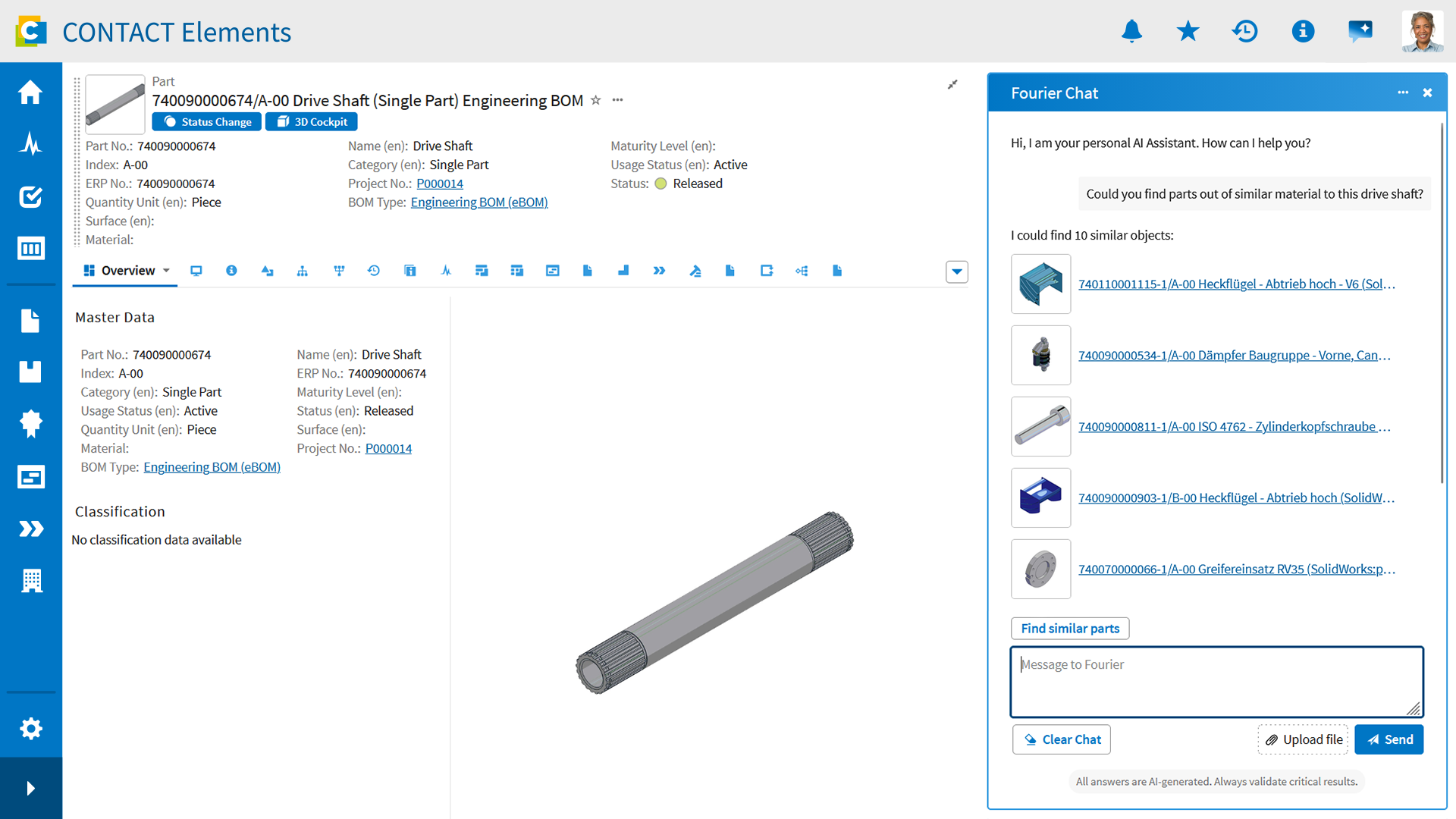
In many companies, identical or highly similar components exist multiple times because they are mislabeled or incompletely classified. Semantic Search holistically analyzes technical descriptions, properties, and relationships, identifying functionally comparable parts even if their names differ. Design engineers find existing solutions faster, avoid creating unnecessary new items, lay the foundation for greater standardization, and sustainably reduce part variety.
Smartly reuse components and geometries
In many companies, identical or highly similar components exist multiple times because they are mislabeled or incompletely classified. Semantic Search holistically analyzes technical descriptions, properties, and relationships, identifying functionally comparable parts even if their names differ. Design engineers find existing solutions faster, avoid creating unnecessary new items, lay the foundation for greater standardization, and sustainably reduce part variety.
In many companies, identical or highly similar components exist multiple times because they are mislabeled or incompletely classified. Semantic Search holistically analyzes technical descriptions, properties, and relationships, identifying functionally comparable parts even if their names differ. Design engineers find existing solutions faster, avoid creating unnecessary new items, lay the foundation for greater standardization, and sustainably reduce part variety.
Safeguard implicit company knowledge and make it accessible
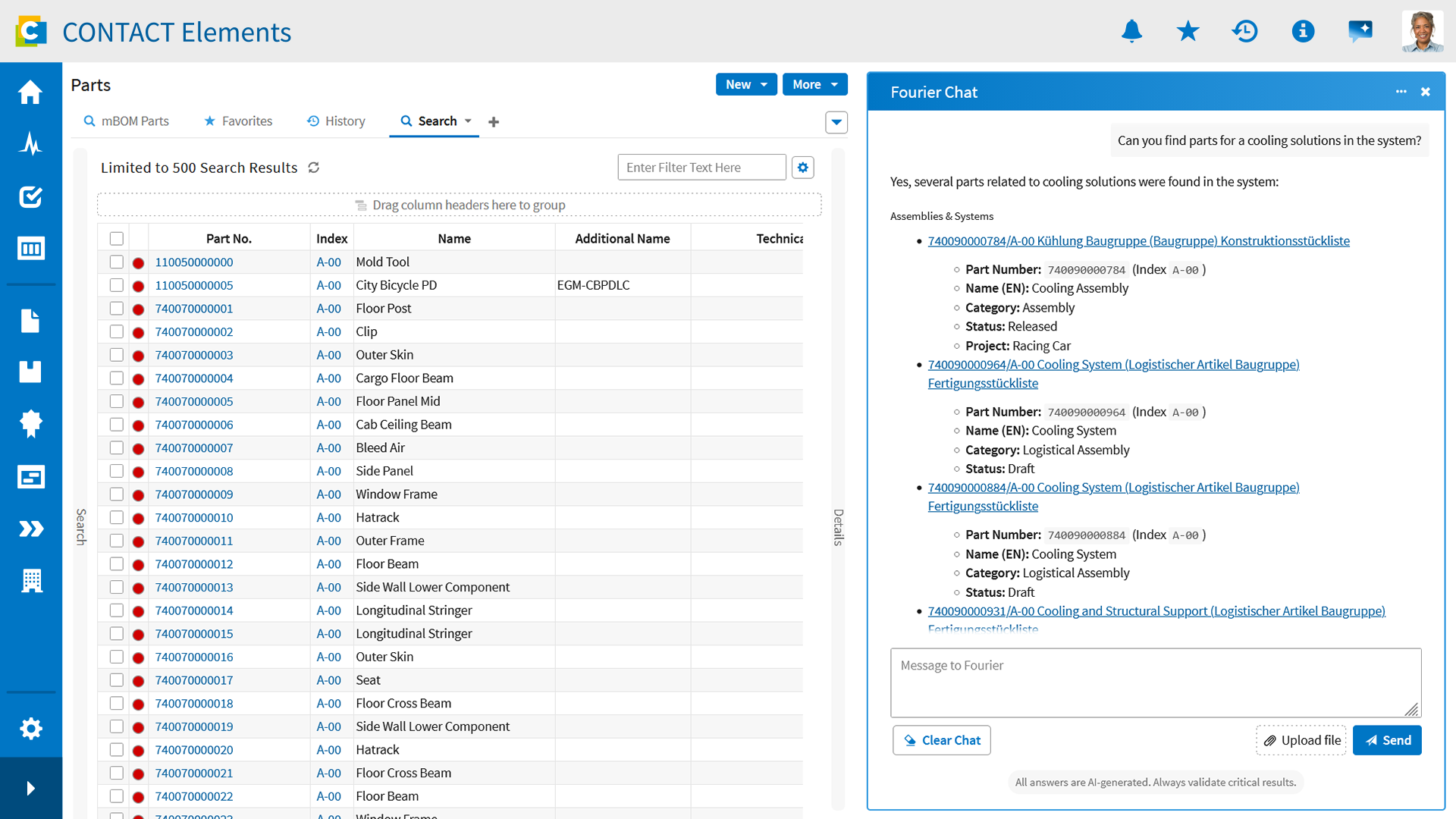
Valuable know-how is often embedded in decades of documentation, past projects, and the individual experience of key experts. If this knowledge is lost or difficult to locate, it creates unnecessary risks and extra work. Employees can ask Semantic Search questions in natural language and receive relevant documents, calculations, CAD models, or best practices directly. This makes existing knowledge permanently available and easily accessible to all teams.
Safeguard implicit company knowledge and make it accessible
Valuable know-how is often embedded in decades of documentation, past projects, and the individual experience of key experts. If this knowledge is lost or difficult to locate, it creates unnecessary risks and extra work. Employees can ask Semantic Search questions in natural language and receive relevant documents, calculations, CAD models, or best practices directly. This makes existing knowledge permanently available and easily accessible to all teams.
Valuable know-how is often embedded in decades of documentation, past projects, and the individual experience of key experts. If this knowledge is lost or difficult to locate, it creates unnecessary risks and extra work. Employees can ask Semantic Search questions in natural language and receive relevant documents, calculations, CAD models, or best practices directly. This makes existing knowledge permanently available and easily accessible to all teams.
Analyze errors in seconds

In service scenarios, every minute counts. Yet technical issues are rarely described the exact same way. While one team refers to a “jammed pump,” another might document a “flow stall in the unit.” Semantic search recognizes the technical meaning behind the terminology and automatically links service tickets, QA reports, maintenance documentation, and institutional knowledge. This enables technicians to reach the right solution faster, significantly reducing downtime and response times.
Analyze errors in seconds
In service scenarios, every minute counts. Yet technical issues are rarely described the exact same way. While one team refers to a “jammed pump,” another might document a “flow stall in the unit.” Semantic search recognizes the technical meaning behind the terminology and automatically links service tickets, QA reports, maintenance documentation, and institutional knowledge. This enables technicians to reach the right solution faster, significantly reducing downtime and response times.

In service scenarios, every minute counts. Yet technical issues are rarely described the exact same way. While one team refers to a “jammed pump,” another might document a “flow stall in the unit.” Semantic search recognizes the technical meaning behind the terminology and automatically links service tickets, QA reports, maintenance documentation, and institutional knowledge. This enables technicians to reach the right solution faster, significantly reducing downtime and response times.
Further information
Would you like to find out more about this topic? Choose one of the following information offers.

