



Multimodal Similarity
Find existing solutions across modalities and reuse them effectively
Avoid overlooking existing solutions in large data sets
As product portfolios grow, so does the volume of existing parts, assemblies, documents, and 3D CAD data. This makes it increasingly difficult for engineers to reliably find existing or similar solutions, especially when names or classifications provide no clear clues. Suitable designs remain undiscovered and are developed again, creating redundant work and consuming valuable engineering time. The key is therefore to make existing solutions quickly accessible as a basis for new development tasks, regardless of their data format.
Benefits
- Find existing parts and designs regardless of naming or classification
- Search product information multimodally across text, images, and 3D geometry
- Identify proven solutions early and reuse them effectively
- Reduce redundant development work and shorten development cycles
- Unlock engineering knowledge in the product context and leverage it for new tasks

Find similar designs using 3D geometry
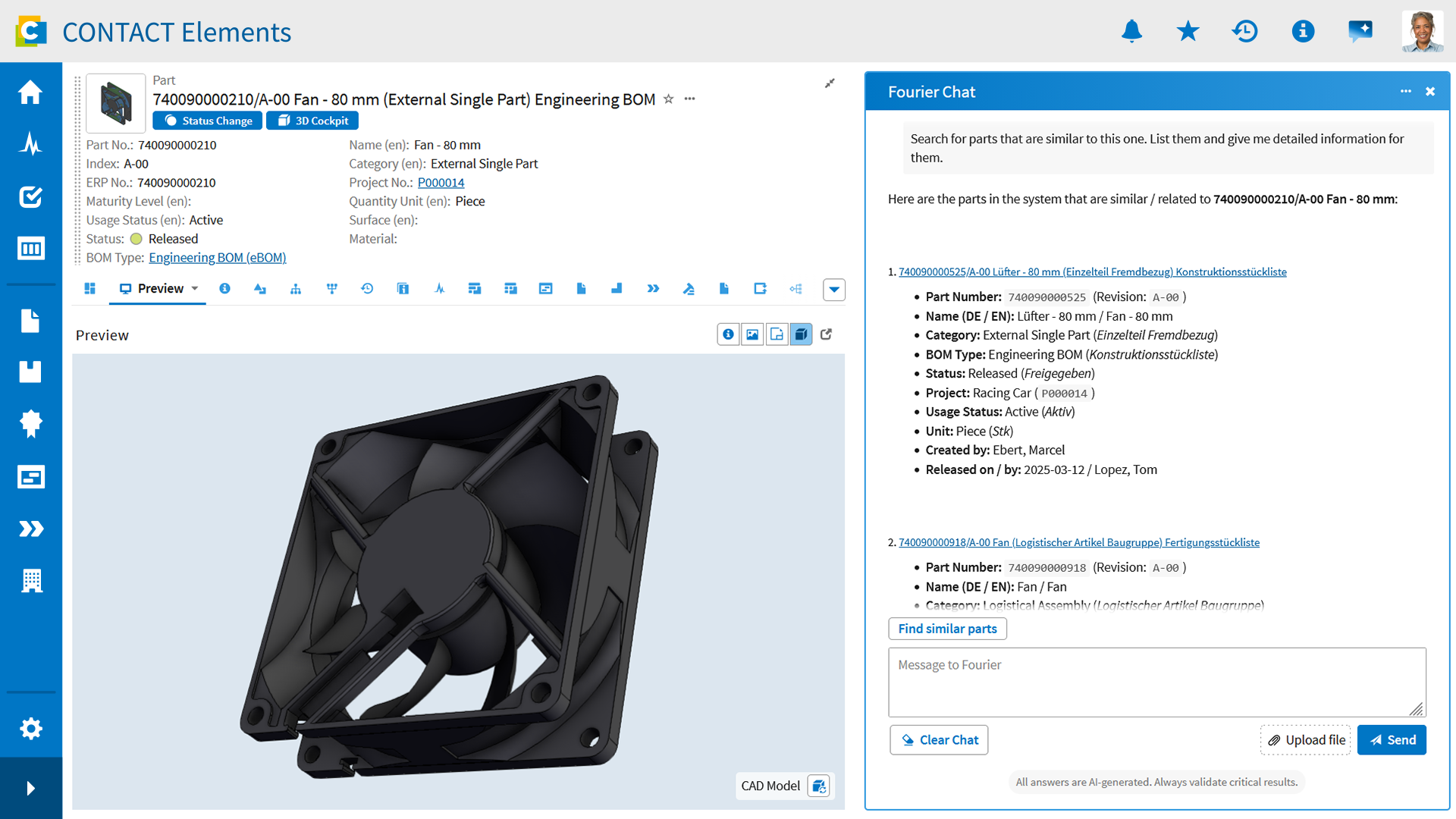
When working with large volumes of 3D CAD data, searching by name or classification is not always sufficient to reliably discover existing designs. Multimodal Similarity uses AI models developed by CONTACT to identify similarities between 3D geometries. This allows engineers to locate existing or similar parts and assemblies in the product data, even when they have different names or are insufficiently classified. Existing designs become easy to find and can serve as a starting point for new development tasks. This reduces unnecessary new development and supports the systematic reuse of existing solutions.
Find similar designs using 3D geometry
When working with large volumes of 3D CAD data, searching by name or classification is not always sufficient to reliably discover existing designs. Multimodal Similarity uses AI models developed by CONTACT to identify similarities between 3D geometries. This allows engineers to locate existing or similar parts and assemblies in the product data, even when they have different names or are insufficiently classified. Existing designs become easy to find and can serve as a starting point for new development tasks. This reduces unnecessary new development and supports the systematic reuse of existing solutions.
When working with large volumes of 3D CAD data, searching by name or classification is not always sufficient to reliably discover existing designs. Multimodal Similarity uses AI models developed by CONTACT to identify similarities between 3D geometries. This allows engineers to locate existing or similar parts and assemblies in the product data, even when they have different names or are insufficiently classified. Existing designs become easy to find and can serve as a starting point for new development tasks. This reduces unnecessary new development and supports the systematic reuse of existing solutions.
Search for solutions using different data formats

A development task does not always begin with a known part name or an unambiguous classification. Relevant information may be available as text, an image, or a 3D CAD model. Multimodal Similarity combines these different data formats in a multimodal similarity search. A single query can therefore lead to existing or similar parts, designs, and related documents. Product information can be found based on similarity rather than identical names alone. In this way, the search unlocks existing information across different data formats and facilitates its continued use in the digital thread.
Search for solutions using different data formats
A development task does not always begin with a known part name or an unambiguous classification. Relevant information may be available as text, an image, or a 3D CAD model. Multimodal Similarity combines these different data formats in a multimodal similarity search. A single query can therefore lead to existing or similar parts, designs, and related documents. Product information can be found based on similarity rather than identical names alone. In this way, the search unlocks existing information across different data formats and facilitates its continued use in the digital thread.

A development task does not always begin with a known part name or an unambiguous classification. Relevant information may be available as text, an image, or a 3D CAD model. Multimodal Similarity combines these different data formats in a multimodal similarity search. A single query can therefore lead to existing or similar parts, designs, and related documents. Product information can be found based on similarity rather than identical names alone. In this way, the search unlocks existing information across different data formats and facilitates its continued use in the digital thread.
Reuse existing solutions early in development

When similar designs are found too late—or not at all—avoidable development work results. Multimodal Similarity helps engineers identify existing solutions during the early stages of development. Instead of starting a design from scratch, they can use similar parts and assemblies from the existing product portfolio as a starting point. A time-consuming manual search becomes a targeted reuse process. Existing engineering knowledge no longer remains hidden in individual product versions, but becomes available for new tasks. This reduces redundant work and accelerates product development.
Reuse existing solutions early in development
When similar designs are found too late—or not at all—avoidable development work results. Multimodal Similarity helps engineers identify existing solutions during the early stages of development. Instead of starting a design from scratch, they can use similar parts and assemblies from the existing product portfolio as a starting point. A time-consuming manual search becomes a targeted reuse process. Existing engineering knowledge no longer remains hidden in individual product versions, but becomes available for new tasks. This reduces redundant work and accelerates product development.

When similar designs are found too late—or not at all—avoidable development work results. Multimodal Similarity helps engineers identify existing solutions during the early stages of development. Instead of starting a design from scratch, they can use similar parts and assemblies from the existing product portfolio as a starting point. A time-consuming manual search becomes a targeted reuse process. Existing engineering knowledge no longer remains hidden in individual product versions, but becomes available for new tasks. This reduces redundant work and accelerates product development.
Access related product information in context

An existing design is relevant not only as a geometric object. The information associated with it may also be essential for reuse. Fourier AI’s multimodal similarity search makes it possible to locate existing or similar parts, designs, and related documents across text, image, and 3D CAD data. Search results are therefore embedded in the existing product information context. Engineers gain access to information that is already available instead of seeing only an isolated geometric match. This makes the existing data more useful for subsequent development tasks.
Access related product information in context
An existing design is relevant not only as a geometric object. The information associated with it may also be essential for reuse. Fourier AI’s multimodal similarity search makes it possible to locate existing or similar parts, designs, and related documents across text, image, and 3D CAD data. Search results are therefore embedded in the existing product information context. Engineers gain access to information that is already available instead of seeing only an isolated geometric match. This makes the existing data more useful for subsequent development tasks.

An existing design is relevant not only as a geometric object. The information associated with it may also be essential for reuse. Fourier AI’s multimodal similarity search makes it possible to locate existing or similar parts, designs, and related documents across text, image, and 3D CAD data. Search results are therefore embedded in the existing product information context. Engineers gain access to information that is already available instead of seeing only an isolated geometric match. This makes the existing data more useful for subsequent development tasks.
Further information
Would you like to find out more about this topic? Choose one of the following information offers.

