



Knowledge & Data Exploration
Unlocking product knowledge across data and information boundaries
Distributed engineering knowledge hinders sound decision-making
Product knowledge is created in many places: structured data, requirements, simulations, standards, and project deliverables. To address specific questions, specialists must identify and evaluate relevant information and establish connections between disparate sources themselves. As a result, valuable insights often remain hidden or are accessible only to those with specialized data expertise. At the same time, the company’s knowledge base grows with every project. It is therefore crucial to make this knowledge systematically usable for new questions – beyond individual sources and subject-matter experts.
Benefits
- Explore product and engineering data easily using natural language
- Get well-founded answers without database or query expertise
- Identify relationships across distributed engineering information
- Effectively reuse existing knowledge from previous projects
- Preserve expert knowledge and make it accessible across teams

Answer technical questions directly with product data
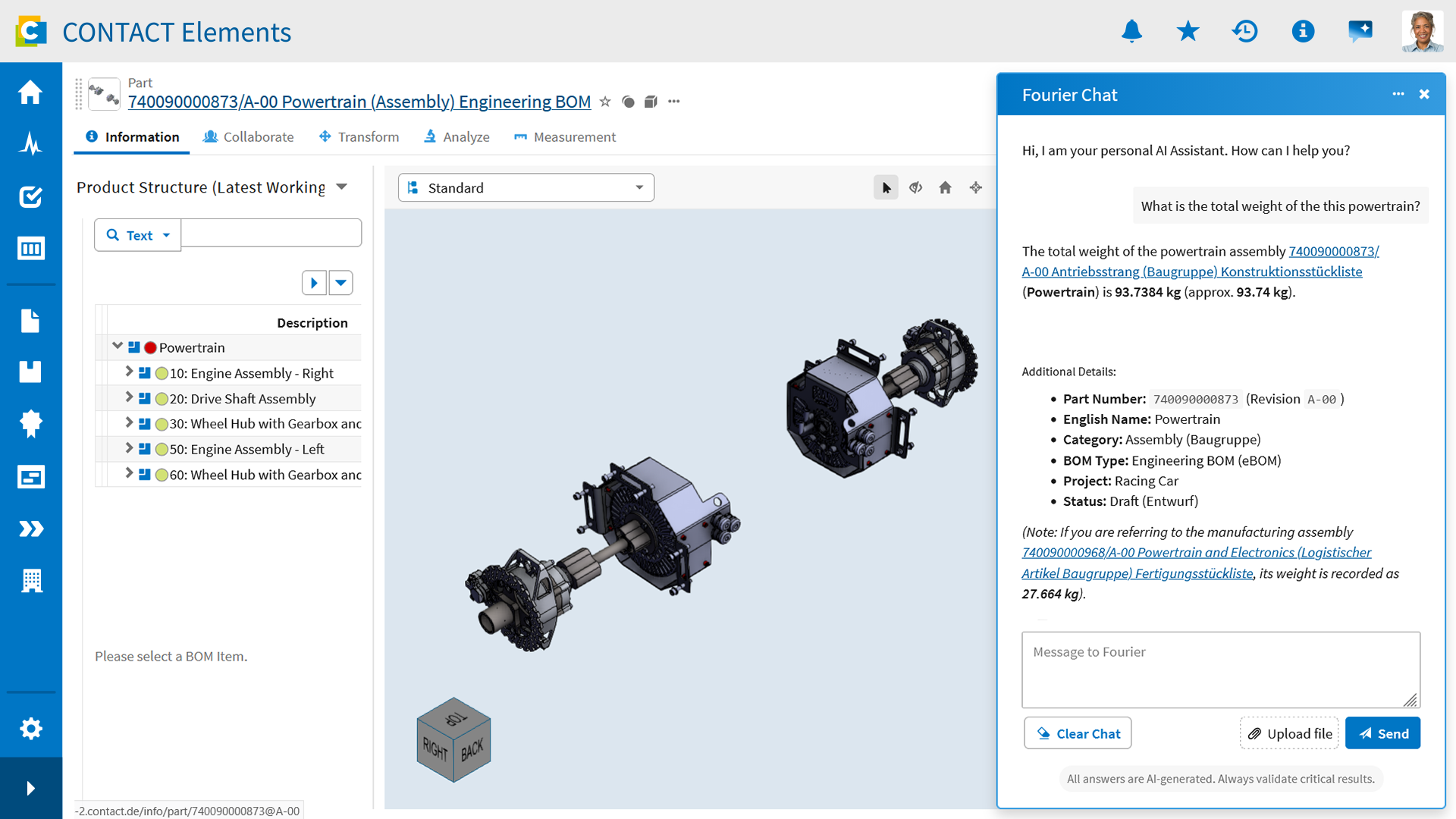
Sound decisions require concrete product and engineering data. Until now, access to this data has often depended on whether users are familiar with the underlying data structures and appropriate query methods. Knowledge & Data Exploration enables users to ask questions about data objects in CONTACT Elements using natural language. Fourier AI translates the domain-specific question into the appropriate query format and retrieves the relevant information. For example, precise metrics from structured data are directly available for technical inquiries without requiring in-depth database or query expertise.
Answer technical questions directly with product data
Sound decisions require concrete product and engineering data. Until now, access to this data has often depended on whether users are familiar with the underlying data structures and appropriate query methods. Knowledge & Data Exploration enables users to ask questions about data objects in CONTACT Elements using natural language. Fourier AI translates the domain-specific question into the appropriate query format and retrieves the relevant information. For example, precise metrics from structured data are directly available for technical inquiries without requiring in-depth database or query expertise.
Sound decisions require concrete product and engineering data. Until now, access to this data has often depended on whether users are familiar with the underlying data structures and appropriate query methods. Knowledge & Data Exploration enables users to ask questions about data objects in CONTACT Elements using natural language. Fourier AI translates the domain-specific question into the appropriate query format and retrieves the relevant information. For example, precise metrics from structured data are directly available for technical inquiries without requiring in-depth database or query expertise.
Recognize connections across engineering information

Relevant insights rarely stem from a single information object. Requirements, simulations, and standards represent different perspectives on the same technical context. Knowledge & Data Exploration links this content semantically, making its connections actionable for user inquiries. This allows users to view information in context rather than analyzing isolated sources. The digital thread thus becomes the foundation for end-to-end knowledge exploration: existing engineering information can be tapped in its proper context, providing a solid basis for technical assessments and decisions.
Recognize connections across engineering information
Relevant insights rarely stem from a single information object. Requirements, simulations, and standards represent different perspectives on the same technical context. Knowledge & Data Exploration links this content semantically, making its connections actionable for user inquiries. This allows users to view information in context rather than analyzing isolated sources. The digital thread thus becomes the foundation for end-to-end knowledge exploration: existing engineering information can be tapped in its proper context, providing a solid basis for technical assessments and decisions.

Relevant insights rarely stem from a single information object. Requirements, simulations, and standards represent different perspectives on the same technical context. Knowledge & Data Exploration links this content semantically, making its connections actionable for user inquiries. This allows users to view information in context rather than analyzing isolated sources. The digital thread thus becomes the foundation for end-to-end knowledge exploration: existing engineering information can be tapped in its proper context, providing a solid basis for technical assessments and decisions.
Uncover hidden connections between project deliverables

Insights from previous projects deliver maximum value when they can be resurfaced in new contexts. However, relevant connections are not always obvious and may be scattered across different project deliverables. Knowledge & Data Exploration brings information together in a cohesive knowledge context, revealing relationships that remain hidden when sources are viewed separately. This ensures that existing results remain available for new inquiries beyond their original project scope. Accumulated engineering knowledge can be directly reused rather than rebuilt from scratch for every new task.
Uncover hidden connections between project deliverables
Insights from previous projects deliver maximum value when they can be resurfaced in new contexts. However, relevant connections are not always obvious and may be scattered across different project deliverables. Knowledge & Data Exploration brings information together in a cohesive knowledge context, revealing relationships that remain hidden when sources are viewed separately. This ensures that existing results remain available for new inquiries beyond their original project scope. Accumulated engineering knowledge can be directly reused rather than rebuilt from scratch for every new task.

Insights from previous projects deliver maximum value when they can be resurfaced in new contexts. However, relevant connections are not always obvious and may be scattered across different project deliverables. Knowledge & Data Exploration brings information together in a cohesive knowledge context, revealing relationships that remain hidden when sources are viewed separately. This ensures that existing results remain available for new inquiries beyond their original project scope. Accumulated engineering knowledge can be directly reused rather than rebuilt from scratch for every new task.
Make experience-based knowledge permanently accessible to teams

With every project, not only does a company’s data volume grow, but also the engineering expertise embedded within it. If this knowledge is difficult to find or tied primarily to experienced specialists, personnel changes can make it difficult to leverage. Knowledge & Data Exploration unlocks accumulated information and its interrelationships via natural language. This opens up existing knowledge to additional engineering and management roles. Insights from past work continue to inform new challenges—even if the original experts are no longer with the company.
Make experience-based knowledge permanently accessible to teams
With every project, not only does a company’s data volume grow, but also the engineering expertise embedded within it. If this knowledge is difficult to find or tied primarily to experienced specialists, personnel changes can make it difficult to leverage. Knowledge & Data Exploration unlocks accumulated information and its interrelationships via natural language. This opens up existing knowledge to additional engineering and management roles. Insights from past work continue to inform new challenges—even if the original experts are no longer with the company.

With every project, not only does a company’s data volume grow, but also the engineering expertise embedded within it. If this knowledge is difficult to find or tied primarily to experienced specialists, personnel changes can make it difficult to leverage. Knowledge & Data Exploration unlocks accumulated information and its interrelationships via natural language. This opens up existing knowledge to additional engineering and management roles. Insights from past work continue to inform new challenges—even if the original experts are no longer with the company.
Further information
Would you like to find out more about this topic? Choose one of the following information offers.

