


Unify Production with a Composable MES Software Solution
From rigid silos to resilient production
The Cost of Rigidity — Today’s Production Challenges

In today's highly competitive North American manufacturing landscape, relying on manual processes or rigid, legacy IT architectures is no longer sustainable. Modern plant managers face complex challenges daily:
- Data Fragmentation: Production information is locked in paper-based workflows, isolated spreadsheets, or disconnected legacy software
- Unplanned Downtime: A lack of real-time machine transparency leads to costly, reactive maintenance instead of proactive, usage-based planning
- Rising Input Costs: Unmonitored energy spikes and manufacturing scrap silently erode profitability
Solving these challenges demands a smarter, fully connected way forward.
The Cost of Rigidity — Today’s Production Challenges
In today's highly competitive North American manufacturing landscape, relying on manual processes or rigid, legacy IT architectures is no longer sustainable. Modern plant managers face complex challenges daily:
- Data Fragmentation: Production information is locked in paper-based workflows, isolated spreadsheets, or disconnected legacy software
- Unplanned Downtime: A lack of real-time machine transparency leads to costly, reactive maintenance instead of proactive, usage-based planning
- Rising Input Costs: Unmonitored energy spikes and manufacturing scrap silently erode profitability
Solving these challenges demands a smarter, fully connected way forward.
The Smart Factory Outlook — Unified, Composable, and Future-Ready

The future of manufacturing is adaptive, connected, and unified. To remain competitive, companies are moving away from restrictive, monolithic MES environments. The modern alternative is a composable, open platform that connects the physical shop floor to enterprise IT (PLM and ERP). By utilizing real-time digital twins of your assets, you can turn raw shop floor data into dynamic, strategic decisions.
Turning this vision into reality starts with a truly agile platform approach.
The Smart Factory Outlook — Unified, Composable, and Future-Ready
The future of manufacturing is adaptive, connected, and unified. To remain competitive, companies are moving away from restrictive, monolithic MES environments. The modern alternative is a composable, open platform that connects the physical shop floor to enterprise IT (PLM and ERP). By utilizing real-time digital twins of your assets, you can turn raw shop floor data into dynamic, strategic decisions.
Turning this vision into reality starts with a truly agile platform approach.
Meet Your New Command Center: MES with CONTACT Elements
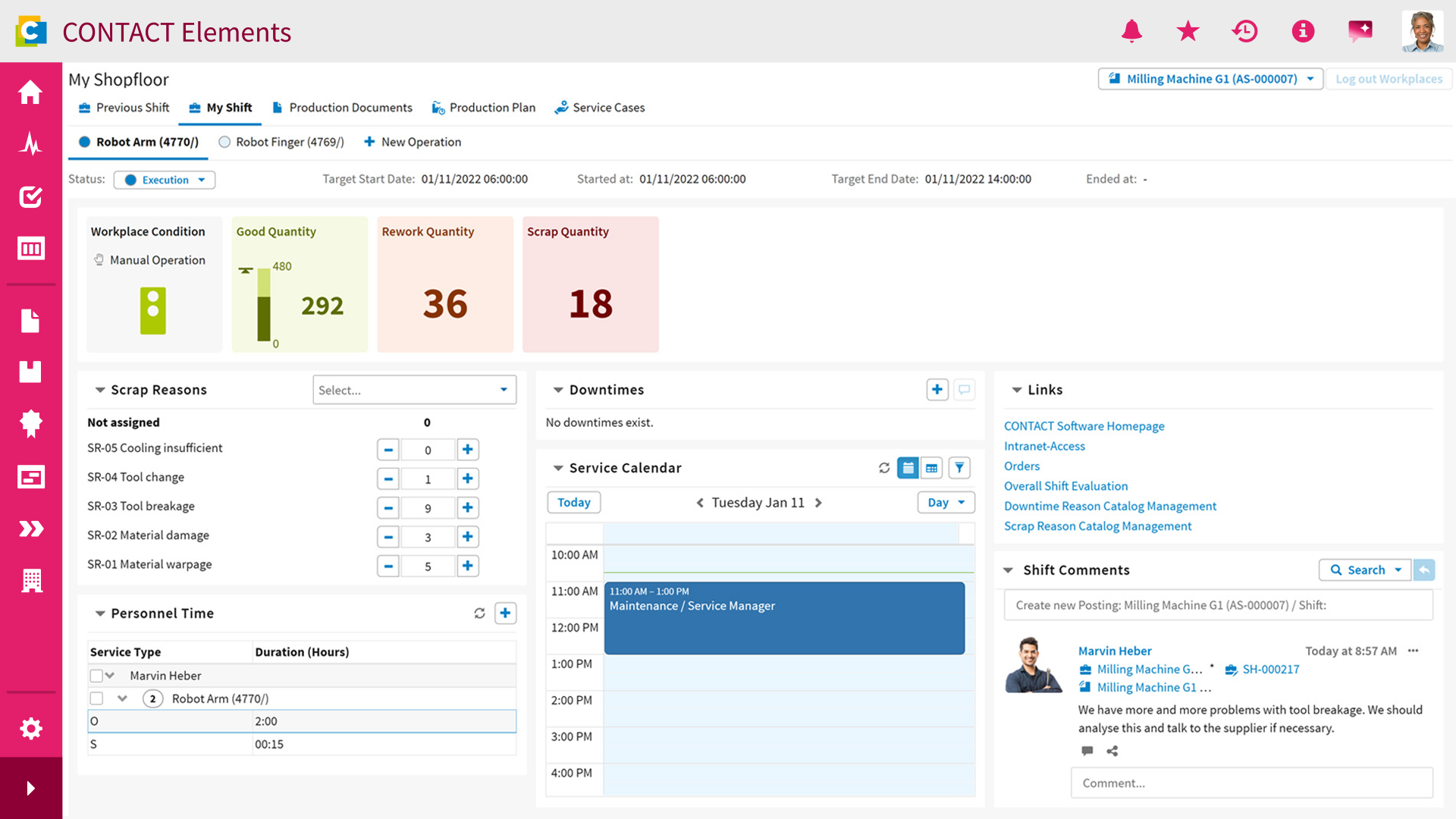
Traditional manufacturing execution system software is often difficult to configure and expensive to maintain.
With MES on our CONTACT Elements platform you get a powerful, low-code solution. Instead of forcing your teams into rigid workflows, it operates as a flexible, live digital twin of your entire production ecosystem. From order scheduling and workforce dispatching to asset connectivity, machine status tracking, and active energy management—you get 100% real-time transparency in a single, intuitive interface.
Meet Your New Command Center: MES with CONTACT Elements
Traditional manufacturing execution system software is often difficult to configure and expensive to maintain.
With MES on our CONTACT Elements platform you get a powerful, low-code solution. Instead of forcing your teams into rigid workflows, it operates as a flexible, live digital twin of your entire production ecosystem. From order scheduling and workforce dispatching to asset connectivity, machine status tracking, and active energy management—you get 100% real-time transparency in a single, intuitive interface.
Why Leading Manufacturers Choose Our Solution
Legacy machines and new automated hardware often speak different languages, leaving plant managers blind to real-time performance and relying on delayed shift reports. Our mes system solves this by connecting all equipment—old and new—using open protocols like OPC UA. You get live OEE tracking and instant performance data pushed directly to your dashboards, enabling immediate, on-the-spot adjustments.
Traditional manufacturing execution system software is rigid, requiring slow, expensive IT support just to change a workflow or a simple operator dashboard. Built on the modular CONTACT Elements platform, our low-code solution allows your team to easily customize layouts, adjust schedules, and scale production on the fly—giving you maximum agility without the high IT overhead.
When maintenance schedules and utility tracking are isolated from daily production, factories suffer from unplanned downtime and invisible energy spikes. This mes software solution unifies shop floor execution with live machine health and energy monitoring. You can prevent costly breakdowns with usage-based maintenance and pinpoint energy-draining processes before they impact your bottom line.
Information silos between business planning (ERP), engineering (PLM), and physical production lead to outdated assembly specs, manual data entry, and expensive rework. Our platform uses modern APIs to establish a continuous digital thread, instantly pushing design updates directly to operators' screens to ensure 100% quality and zero communication gaps.

